Table of Contents
Tired of the content treadmill? You've recorded a great podcast or webinar, but the pressure to constantly feed social media algorithms is relentless. The good news is you don't need to create more content—you need a system to get more from the content you already have.
Effective content repurposing strategies turn one long-form video or audio file into a week's worth of high-quality social posts. Success isn't about working harder; it's about turning your core content into a repeatable engine that drives consistent engagement and growth.
This guide breaks down 10 practical content repurposing strategies you can use immediately. You'll learn exactly how to turn long-form content into short-form clips, quote cards, blog posts, and more, complete with actionable workflows.
1. Long-Form to Short-Form Video Clipping
This is one of the most powerful content repurposing strategies. It involves extracting short, high-impact clips from longer videos like podcasts, webinars, or interviews. Instead of creating new content from scratch for TikTok, Instagram Reels, and YouTube Shorts, you turn one core recording into dozens of shareable moments.
This method maximizes the return on your initial effort. Thought leaders like Gary Vaynerchuk and the Huberman Lab podcast have built massive audiences by consistently atomizing long conversations into digestible, platform-native clips.
The easiest tool to make short videos
The goal is to find "golden nuggets" in your content—a surprising statistic, an actionable tip, or an emotional story—and isolate them.
Flowjin is an AI-powered tool for creators and marketers that automatically turns long-form video and audio into a steady stream of social-ready short clips. It analyzes your content's transcript to identify the most promising clips, saving you hours of manual review.
Once identified, these segments are automatically formatted for vertical video (9:16), branded with your logos, and enhanced with animated captions to capture attention even with the sound off.
Actionable Implementation Steps
- Upload Your Content to Flowjin: Connect your YouTube, Zoom, or upload a video/audio file directly. Flowjin’s AI will transcribe it and suggest the best clips.
- Select Your Clips: Review the AI-suggested "golden nuggets" or manually select segments that can stand alone without extensive context.
- Customize and Brand: Apply your brand’s visual identity—logos, fonts, and colors—to every clip with a pre-set template. This builds brand recognition as users scroll.
- Export and Schedule: Download your ready-to-post clips and distribute them across multiple platforms to maximize reach.
2. Quote Graphics and Visual Quote Cards
This strategy transforms powerful audio or video soundbites into static or animated graphics for platforms like Instagram, LinkedIn, and Pinterest. It’s an efficient way to reinforce key messages from your core content with minimal effort.
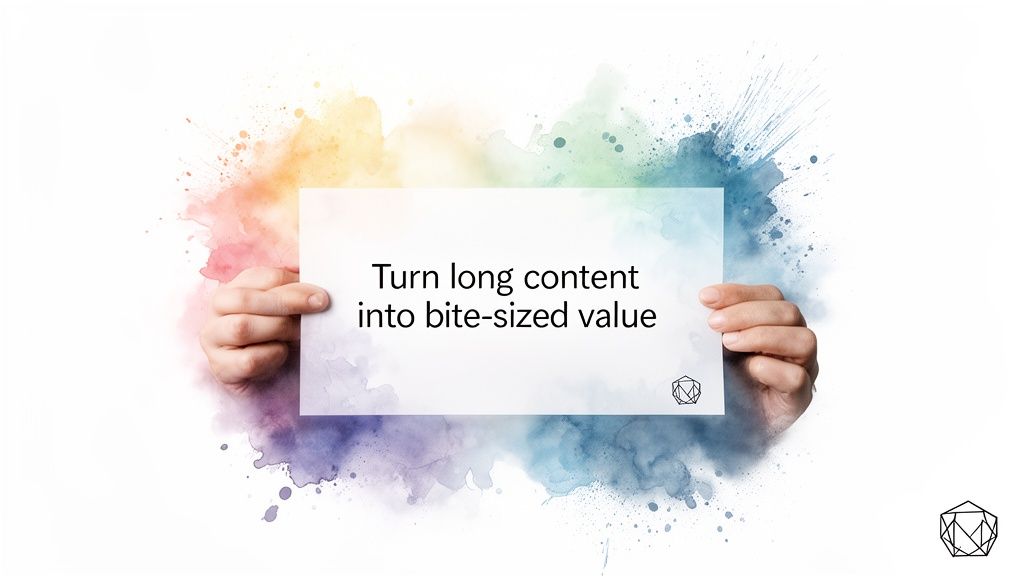
This method gives your spoken words a second life in silent-scroll environments. Thought leaders like Tony Robbins use quote cards to build authority and drive conversations. It's one of the simplest yet most effective content repurposing strategies for extending the reach of your expertise.
How It Works
The process involves isolating concise, impactful statements from your content and placing them on a branded template. The goal is to create a self-contained piece of value that stops the scroll.
Tools like Flowjin can identify these moments automatically. For example, it can suggest key phrases and powerful statements from your transcript that are ideal for creating visual quote cards.
Actionable Implementation Steps
- Upload Your Content to Flowjin: Import your YouTube, Zoom, or upload a video/audio file directly. Flowjin’s AI will transcribe it and finds the best quotes.
- Select Your quotes: Review the quotes Flowjin found from your content and choose the best ones that resonate with your audience.
- Design a Branded Template: Create a consistent visual template using your brand's fonts, colors, and logo. Ensure the text is large and readable on mobile.
- Generate and Export: Place the quotes onto your template to create a series of graphics. Aim for 5-10 quote variations from each piece of long-form content.
- Pair with a Compelling Caption: When posting, use the caption to provide brief context or ask a question related to the quote to encourage discussion.
3. Audiogram Creation and Audio Visual Mashups
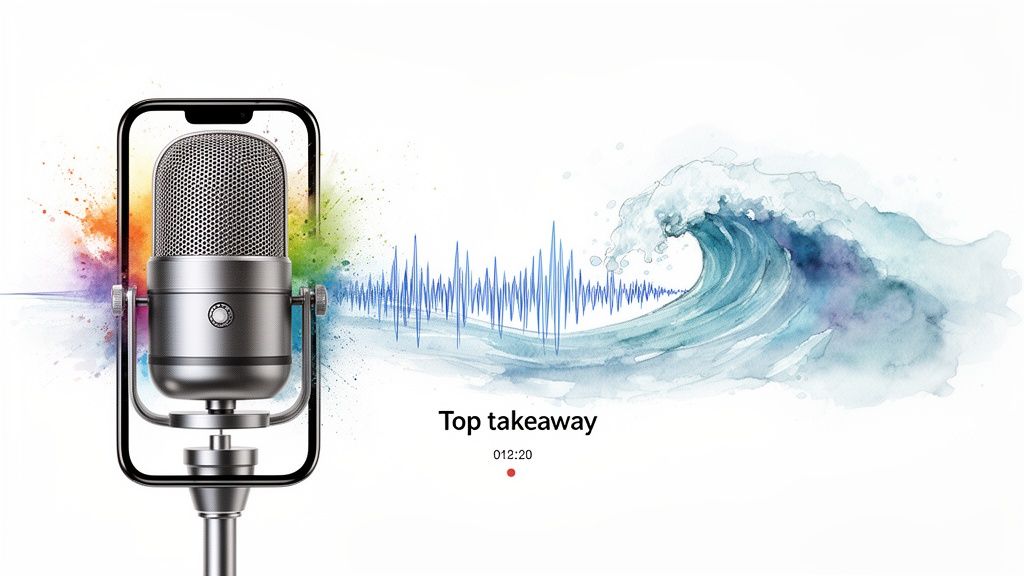
This strategy transforms audio-only assets into engaging videos for platforms like Instagram, LinkedIn, and TikTok. By layering your audio with visual elements like animated waveforms and scrolling captions, you make your content discoverable to a whole new audience.
This tactic brilliantly bridges the gap between your audio-first content and video-first platforms. Creators like The Joe Rogan Experience have popularized this method, turning passive audio snippets into thumb-stopping social media posts.
How It Works
The goal is to give your audio a visual anchor. Instead of a static image, an audiogram provides motion and text that capture attention. The waveform pulses in sync with the speech, while captions ensure the message is understood with the sound off.
Tools like Flowjin automatically generate these visual elements. You can upload a podcast episode, and the AI will identify key moments, transcribe them, and package them into ready-to-share audiogram videos, complete with your branding.
Actionable Implementation Steps
- Select a High-Impact Audio Clip: Isolate a segment from your podcast that delivers a strong opinion, a surprising fact, or a compelling story.
- Generate the Visuals: Use a tool to create a moving waveform that syncs with your audio. Add a branded background image.
- Add Animated Captions: Transcribe the audio and overlay dynamic, easy-to-read captions. Use high-contrast colors and a bold font.
- Distribute on Visual Platforms: Share the final audiogram on Instagram (Reels, Stories, Feed), LinkedIn, TikTok, and YouTube Shorts.
4. Transcription-Based Written Content (Blog Posts, LinkedIn Articles, Threads)
This content repurposing strategy transforms spoken audio or video into valuable written assets. By transcribing podcasts, webinars, or interviews, you unlock a wealth of searchable content that can fuel your blog, articles, and newsletters without starting from a blank page.
This approach turns ephemeral, spoken-word content into evergreen written resources that attract organic traffic for years. It bridges the gap between passive listening and active reading, catering to different audience preferences.
How It Works
The process starts by converting the audio from your video or podcast into a text file. AI-powered transcription services have made this step faster and more accurate than ever.
Once transcribed, the raw text is refined for readability. This involves cleaning up conversational language, adding structural elements like headings and lists, and optimizing the content for search engines.
Actionable Implementation Steps
- Generate an Accurate Transcript: Use a reliable service to transcribe your long-form audio or video. For platform-specific content like X (Twitter) Spaces, explore the best Twitter Space transcriber options to streamline this.
- Edit for Clarity: Review the transcript to remove filler words ("um," "ah"), fix grammatical errors, and restructure sentences for a written format.
- Structure and Format: Add H2/H3 headings, bullet points, and bold text to guide the reader. Include relevant images and quotes.
- Optimize and Distribute: Integrate relevant keywords to improve search engine visibility. Publish the final piece on your blog or LinkedIn, and link back to the original video or audio.
5. Content Summary and Key Takeaway Distribution
This strategy distills your long-form content into its most valuable, bite-sized insights. Instead of asking your audience to commit to an hour-long webinar, you provide them with a high-value summary or a list of key takeaways. This respects their time and serves as a hook to drive traffic back to the original asset.
This is one of the most effective content repurposing strategies for establishing thought leadership. Brands like Morning Brew have built entire businesses on this model, proving that audiences crave well-synthesized knowledge.
How It Works
The goal is to extract the "aha!" moments from your pillar content and present them in a highly scannable format, like a "Top 5 Takeaways" graphic for Instagram or a bulleted summary in an email newsletter.
AI-powered tools can accelerate this by generating transcripts and summaries, making it easy to pinpoint the most impactful statements or data points without re-watching the entire recording.
Actionable Implementation Steps
- Identify Core Insights: Review your long-form content and pull out the 3-7 most important, actionable, or surprising points.
- Format for Scannability: Present these takeaways using numbered lists or bullet points. For visual platforms, turn each takeaway into a slide in a carousel post.
- Add Context and Credit: Briefly mention the original source and credit any guests or speakers.
- Drive Back to the Source: Always include a clear call-to-action (CTA) that links back to the full content piece, inviting the audience to dive deeper.
6. Platform-Specific Copy and Caption Adaptation
Posting the same video clip with identical copy across all platforms is a missed opportunity. This strategy focuses on tailoring your titles, descriptions, and hashtags to each social platform's unique algorithm and audience. It acknowledges that a user on LinkedIn is in a different mindset than someone on TikTok.
This nuanced approach ensures your repurposed content feels native to each platform, dramatically increasing its engagement potential. Instead of a one-size-fits-all broadcast, you're having optimized conversations with different segments of your audience.
How It Works
The core principle is to adapt your messaging to match the platform's user intent. For a repurposed video clip, this means a professional headline for LinkedIn, an intriguing title for YouTube, and a short, punchy caption for TikTok.
For instance, a clip about a business framework would be positioned on LinkedIn with hashtags like #BusinessStrategy. On Instagram, the same clip might use more aspirational hashtags like #EntrepreneurLife.
Actionable Implementation Steps
- Define Platform Voice: Document the appropriate tone for each channel: professional (LinkedIn), casual (TikTok), or informative (YouTube).
- Customize Headlines: Write a unique opening line for each platform. On YouTube, focus on searchable titles. For TikTok and Reels, create a hook that stops the scroll.
- Research Platform-Specific Hashtags: Use a mix of broad, niche, and trending hashtags relevant to each platform.
- Adapt Calls-to-Action (CTAs): Tailor your CTA to the platform's capabilities. Use "Link in Bio" on Instagram, prompt for comments on Facebook, and direct users to a resource link on LinkedIn.
7. Series and Narrative Arc Development from Single Content Pieces
This advanced strategy transforms a single piece of content into an episodic series. Instead of releasing one-off clips, you create a cohesive narrative that unfolds over multiple posts. This builds anticipation and turns passive followers into a dedicated audience.
By structuring your content as a mini-series, you extend its lifecycle and boost retention. This method is particularly effective for deep-dive interviews or educational webinars where the information can be broken down into sequential chapters.
How It Works
The goal is to deconstruct a long-form asset into logical segments. Each segment becomes an "episode," often framed with "Part 1 of 5." This creates a psychological loop, compelling viewers to follow along to get the complete picture.
Platforms that favor sequential content, like LinkedIn carousels or Instagram Story sequences, are perfect for this. The strategy focuses on maintaining a consistent release schedule to build a consumption habit.
Actionable Implementation Steps
- Identify Natural Story Arcs: Review your long-form content and map out the key themes or steps. A 90-minute interview could be broken into 5-6 distinct thematic clips.
- Create a Series Framework: Develop consistent branding for the series. Use numbered titles (e.g., "Key Concept #1") and a unique hashtag.
- End Each Piece with a Teaser: Conclude every part with a compelling hook or question that will be answered in the next installment.
- Promote the Series Holistically: When you release a new part, link back to the previous ones. Once complete, compile all parts into a single playlist on YouTube or a dedicated blog post.
8. B-Roll and Visual Enhancement Integration
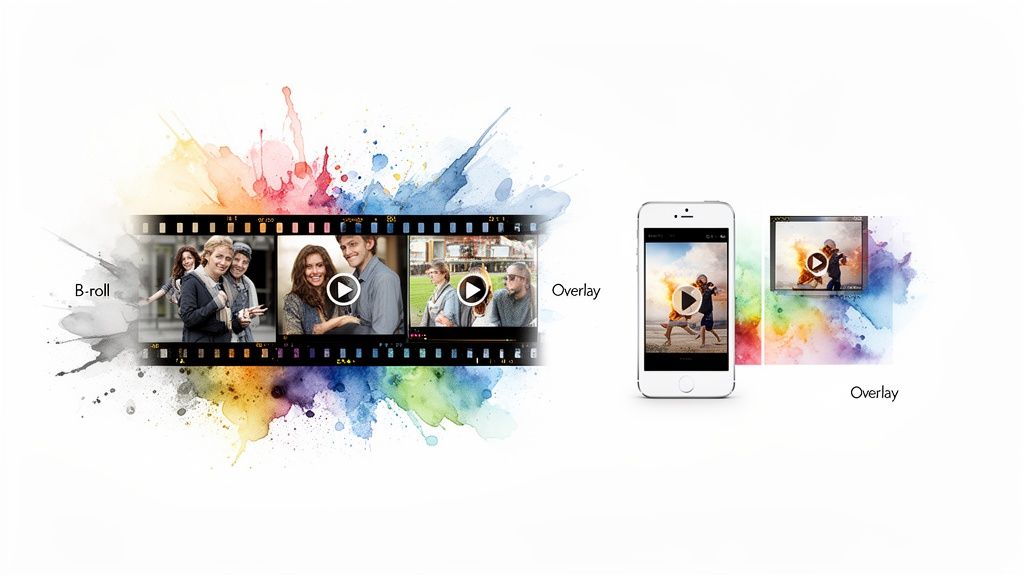
This strategy elevates basic clips into professional assets by layering in supplementary footage (B-roll), graphics, and animations. Instead of a simple talking-head segment, you enrich it with visual context, turning a simple clip into a dynamic, engaging story.
This approach transforms raw clips into broadcast-quality content without new filming sessions. It’s the difference between a static video and a captivating visual experience that holds audience attention.
How It Works
The goal is to visually illustrate what the speaker is discussing. If your host mentions a statistic, an animated chart can appear on screen. This adds a layer of visual information that reinforces the audio.
Tools like Flowjin streamline this by automatically adding contextual B-roll to your extracted clips. The platform analyzes the transcript and inserts relevant stock footage or animations, saving you from sourcing and editing these elements manually.
Actionable Implementation Steps
- Identify Key Visual Moments: Pinpoint concepts in your clip’s transcript that would benefit from visual support.
- Source or Create B-Roll: Gather relevant supplementary footage, such as stock videos, screen recordings, or animated infographics.
- Integrate and Edit: Layer the B-roll over your primary clip, ensuring the cuts are timed with the speaker's words.
- Add Final Polish: Enhance the clip with subtle background music and dynamic elements like speaker tracking to create a well-rounded final product.
9. Cross-Platform Publishing and Unified Calendar Management
This strategy focuses on executing your content distribution with maximum efficiency. It involves using a centralized platform to schedule and publish your repurposed content across multiple social channels, ensuring brand consistency and reducing operational overhead.
Instead of manually logging into TikTok, Instagram, and LinkedIn, you coordinate everything from a single editorial calendar. This systematic approach turns a chaotic posting schedule into a predictable, automated workflow.
How It Works
The core idea is to connect all your social media profiles to a single scheduling tool. You then upload your repurposed content (clips, audiograms) and schedule them to be published at optimal times for each platform.
For example, a short-form video clip can be scheduled for LinkedIn during morning business hours and on Instagram and TikTok during the afternoon commute. This staggered approach respects the unique user behavior of each platform.
Actionable Implementation Steps
- Choose a Central Hub: Select a social media management tool that integrates with your target platforms (e.g., Buffer, Hootsuite, Sprout Social).
- Build a Content Buffer: Upload your library of repurposed assets and aim to have at least two weeks of content ready to go.
- Map Out Your Calendar: Create a publishing schedule based on platform-specific analytics to identify peak engagement times for your audience.
- Automate and Monitor: Let the tool handle publishing automatically. Focus your time on monitoring performance analytics to refine your future strategy.
10. Audience Segment and Format Variation Testing
This strategy elevates content repurposing from distribution into a data-driven optimization engine. It involves creating and testing multiple versions of the same core content to identify what drives the best results. This turns your content into a live experiment for understanding audience preferences.
Instead of guessing what your audience wants, you let the data guide you. This approach is fundamental to high-performance marketing and ensures that every repurposed asset is working to improve key metrics like engagement and conversions.
How It Works
The core principle is to isolate a single variable and test its impact. You might repurpose a video clip and test two different thumbnails or test the same message framed educationally versus entertainingly.
By creating these variations and measuring their performance, you systematically refine your approach. This is one of the most effective content repurposing strategies because it builds a feedback loop, making your content more effective over time.
Actionable Implementation Steps
- Isolate a Single Variable: Test only one element at a time, such as the video thumbnail, the headline, the caption’s tone, or the video length.
- Define Your Success Metric: Know what you are measuring before you start. Are you optimizing for click-through rate (CTR), watch time, or shares?
- Run a Controlled Test: Distribute your variations to similar audience segments for a defined period (typically 1-2 weeks) to gather sufficient data.
- Analyze and Document Results: Document which variation performed best and why. This creates a playbook of learnings you can apply to all future content.
10-Point Content Repurposing Comparison
StrategyImplementation complexityResource requirementsExpected outcomesIdeal use casesKey advantagesLong-Form to Short-Form Video ClippingModerate — AI highlight detection + editingGood-quality long-form source; automated tools; minimal editingHigh content velocity; increased short-form reachPodcasts, webinars, interviews, livestreamsScales content volume; platform-optimized clips; fast publishingQuote Graphics and Visual Quote CardsLow — template-based design & extractionTranscripts; design templates or automation; brand assetsShareable social posts; higher engagement per quoteThought leadership, LinkedIn, newsletters, PinterestLow production cost; highly repostable; easy A/B testingAudiogram Creation and Audio Visual MashupsLow–Moderate — audio sync + animationClean audio; waveform templates; basic visuals/musicVisual discoverability for audio-first creators; good retentionPodcasts, interviews, educational audio snippetsBridges audio to visual platforms; strong retention; quick to produceTranscription-Based Written ContentLow — automated speech-to-text with editingAccurate transcription tool; editor time for polishSEO-friendly evergreen assets; searchable archivesBlogs, LinkedIn articles, long-form written repurposingImproves SEO and accessibility; versatile repurposing formatsContent Summary and Key Takeaway DistributionLow — AI summarization + curationSummarization tool; SME review; formatting templatesFast audience understanding; teasers driving engagementEducational content, newsletters, recap postsRapidly communicates value; drives clicks to originalsPlatform-Specific Copy and Caption AdaptationModerate — tailored copy generationAI copy tools; platform knowledge; review workflowImproved CTR and algorithm performance per platformMulti-channel campaigns across LinkedIn, TikTok, YouTubeMaximizes platform relevance; saves copywriting timeSeries and Narrative Arc DevelopmentModerate–High — planning and sequencingEditorial planning; consistent branding; schedulingExtended content lifecycle; higher retention & habit formationEpisodic interviews, webinars, deep-dive topicsEncourages binge behavior; increases publishing cadenceB-Roll and Visual Enhancement IntegrationModerate–High — visual selection and editingStock footage/library access; design/edits; rendering timeHigher production value; reduced drop-offEducational clips, demos, interview visualsElevates perceived quality; adds contextual visualsCross-Platform Publishing & Unified CalendarModerate — integrations + schedulingPlatform APIs; scheduling tool; analyticsConsistent multi-channel publishing; time savingsTeams managing many channels and campaignsCentralized workflow; reduces operational overheadAudience Segment & Format Variation TestingHigh — A/B framework & analyticsTesting platform; sufficient audience volume; analyticsData-driven optimization; improved ROI over timeBrands optimizing messaging, thumbnails, lengthsIdentifies best-performing variants; enables personalization
Build Your Content Repurposing Engine
You’ve explored ten distinct content repurposing strategies, from transforming long-form videos into a library of social clips to adapting transcriptions into insightful blog posts. Each strategy is a powerful lever to extend the reach and ROI of every asset you create.
The central theme is a shift in mindset: content creation is no longer a linear process of "create, publish, repeat." Instead, view each core piece of content as the start of a strategic distribution plan.
From Strategy to System: Key Takeaways
Mastering content repurposing is about building a repeatable, efficient system. Focus on these core principles:
- Pillar Content is Your Foundation: Start with a high-value, in-depth piece of content like a webinar or podcast. This "pillar" provides the substance needed to fuel dozens of smaller assets.
- Audience and Platform First: Always ask: "Who is this for, and where do they spend their time?" A raw clip might excel on TikTok, while a polished quote card is better for LinkedIn.
- Efficiency is Non-Negotiable: A convoluted, manual workflow is the enemy of consistency. The goal is to minimize friction from the source asset to the final published micro-content.
Your Actionable Next Steps
To transition from understanding to implementing, start small.
- Select Your Core Strategy: Choose one or two methods that align with your content and goals. If you host a podcast, focus on audiograms and transcriptions. If you do webinars, prioritize video clipping.
- Document Your Workflow: Map out the exact steps in a simple checklist to transform the idea into a repeatable process.
- Integrate and Automate: Manually clipping, transcribing, and designing every piece of content is a recipe for burnout. To truly scale your output, learn how to automate content creation. Platforms like Flowjin handle the heavy lifting, allowing you to focus on strategy.
A robust content repurposing system transforms your marketing into a self-sustaining ecosystem. You'll spend less time on the content treadmill and more time engaging with your audience, analyzing performance, and refining your message.
Ready to build your own content repurposing engine without the manual overhead? Flowjin uses AI to turn your long-form videos and podcasts into a steady stream of social-ready clips, transcripts, and more in minutes. Stop spending hours editing and start building a content system that works for you by trying Flowjin today.